
Top Tips on Using Synthetic Data for Training and Testing Your Models and Products
- Published on: October 22, 2026
- Updated on: October 22, 2026
- Reading Time: 7 mins
-
Views
Why Generic Synthetic Data Falls Short in Higher Education Analytics
1. Define Synthetic Test Data Around Your EdTech Product Workflow
2. Choose the Generation Method After Defining the Use Case
3. Validate SIS and LMS Data Beyond Row Counts
4. Make Synthetic Datasets Reproducible for Regression Testing
Be Clear About What Synthetic Data Cannot Prove
Start with One Higher Education Analytics Workflow
FAQs
Consider an EdTech team preparing a student-success dashboard for higher ed. To work well, the product needs enrollment and grade information from a student information system (SIS) and learning activity from a learning management system (LMS).
Your engineering team will probably need to check that those records reconcile, but you don’t yet have an institutional dataset.
Sure, a few sample students can help demonstrate the interface. But they won’t tell your team if the underlying integrations will handle missing identifiers, withdrawals, or inconsistent records.
This was the problem I had a chance to work on in a recent higher education analytics engagement at Magic EdTech. The edtech team needed to create a reusable environment that could support integration testing and demonstrations without using real student records. For technology leaders considering synthetic data, a useful starting point is: What must this dataset allow the team to test?
I’ve laid out my top tips based on this project to help edtech teams utilize synthetic data for edtech
products – for better testing and reconciliation of data.
Why Generic Synthetic Data Falls Short for Testing or Training AI Models
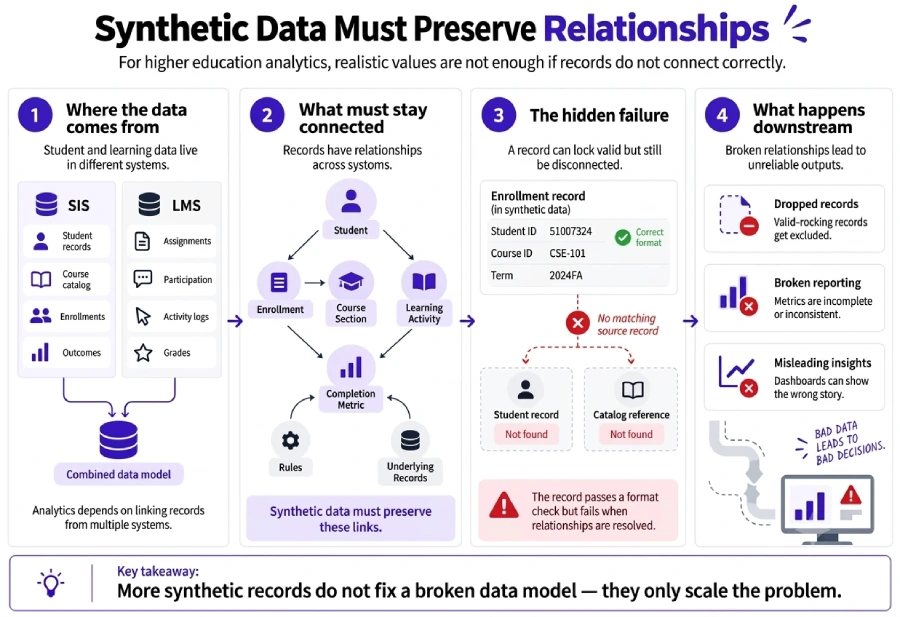
Good higher education analytics depends on moving data sets and describing different parts of a student’s experience on your edtech app.
An SIS would hold information like course catalogs, enrollments, and final outcomes. An LMS contains assignment-level grades, participation, and other learning activities. Connecting those records is a central integration challenge.
What does this have to do with synthetic data? Your synthetic dataset needs more than plausible values in individual fields.
- An enrollment must connect to the appropriate student and course section.
- A learning activity must link to the intended learner.
- A completion measure must follow the edtech product’s agreed rules for interpreting the underlying records.
Now say an enrollment record contains a student identifier in the right format, and no matching student exists. You will pass the format check at the beginning, but later you will lose the enrollment or reports because of that unresolved relationship.
We encountered this kind of problem in the engagement. Some fields held valid-looking identifiers that did not resolve to their backing catalogs.
Generating more records would not have addressed that problem. It would have just reproduced it at a larger scale.
1. Define Synthetic Test Data Around Your EdTech Product Workflow
While building synthetic data for testing, “Generate 10,000 students” can describe volume. It won’t describe what the product needs to do with these data points.
Instead, a more useful requirement might be: “Test whether the pipeline calculates completed credits correctly across different enrollment statuses and academic terms.”
Your product, data engineering, and QA teams now have something specific to work through. Which statuses count toward completion? How much history is needed? Which records establish the expected result? What should happen when the SIS and LMS identifiers do not match?
In our engagement, we captured these decisions in a written specification covering institution profiles, academic calendars, student-success measures, relationships, edge cases, and delivery requirements. An assumptions log recorded the choices behind the generated data. Product and data engineering stakeholders contributed the metric definitions and downstream requirements.
The practical lesson here is to make those assumptions reviewable before they become code. Two examples here:
1. A team testing a withdrawal workflow may deliberately generate more withdrawals than a small institutional extract contains. That is useful for exercising the workflow. However, it should be documented as a test scenario rather than presented as a representative withdrawal rate.
2. The same goes for cross-system mismatches. Deliberately injecting an unresolved identifier can test error handling. Accidentally generating one is a data-quality defect. The specification should make clear which conditions are intentional and what response each test expects.
2. Choose the Generation Method After Defining the Use Case
You can create synthetic data even without a generative AI model.
For this engagement, Magic EdTech selected rule- and distribution-driven generation from a specification. The approach did not require a real institutional training dataset (a big bonus), and you could inspect and adjust its relationships and generation rules.
We deferred models trained on real data because getting a suitable training extract would have reintroduced the access dependency – the very thing the project was intended to avoid.
We also considered masking production records, but that would still have required access to the original records.
These were decisions for this use case, not a ranking of methods for every synthetic data project.
Synthetic data should not be positioned as a way around institutional safeguards. The U.S. Department of Education guidance allows certain disclosures of education records to outside parties under certain conditions. But you need to ask whether your project even needs those records in the first place.
Before choosing a generator, define the intended use, whether real records will be involved, and how the output will be evaluated. NIST’s synthetic-data evaluation work considers both utility and privacy, a useful reminder that these require separate evidence.
3. Validate SIS and LMS Data Beyond Row Counts
A populated database is only the beginning of your validation journey.
a. Schema checks should tell you if the generated data follows the source-system definitions in the scope. This includes your required fields, types, and nullability rules. In our engagement, automated checks used the vendors’ official schemas and definitions rather than locally interpreted versions.
b. Relationship checks to see if your references resolve across tables and systems. A record with an identifier should connect to the expected parent record, unless it belongs to an explicitly defined negative test. In our case, the project’s integrity checks reported unresolved references by table, column, and count.
c. Delivery checks should establish whether the data reaching the analytics pipeline still matches the source. Our project team compared database and export row counts, checked columns and compatible types, and sampled records value by value. That last step addressed defects involving null handling, type conversion, and encoding that row counts alone would miss.
These checks ran as build gates, stopping a build when validation failed. My recommendation here is to make data quality an acceptance condition, rather than leaving downstream teams to discover problems during a demo.
Expected results also need independent review. If the generator and the analytics pipeline contain the same mistaken interpretation of “completed credits,” agreement between them will not expose the mistake. Review product definitions and test expectations separately from the code that implements them.
4. Make Synthetic Datasets Reproducible for Regression Testing
A dataset is more trustworthy when a team can return to the exact conditions under which a test failed.
The environment in our engagement supported regeneration from a recorded seed. Build versions and snapshot manifests provided additional information for tracing which data had been generated and delivered. Together, these controls allowed repeatable testing and investigation.
If a downstream report appears inconsistent, this traceability comes in real handy. During the engagement, downstream integrity alerts were traced to snapshot timing across a data refresh and an export that had not been regenerated after the underlying data changed. Reproducing the conditions helped us establish where the mismatch occurred.
For edtech teams adopting this approach, record the seed, generator version, configuration, and snapshot used for each test. Then make comparisons against the same dataset version. A test is difficult to diagnose when the source and the report describe different moments in time.
Be Clear About What Synthetic Data Cannot Prove
A test environment can demonstrate that an integration handles specified records correctly. It does not automatically establish that a predictive model will perform well on real students.
Consider a generator programmed to associate particular grades and engagement patterns with a retention outcome. A model could perform well on that synthetic data because it learned the rules used to create it. That alone would not show that those relationships hold at an actual institution.
The engagement maintained this boundary. It supported non-production development, integration testing, and demonstrations. Predictive-model parity against real institutional data was not claimed because a real holdout dataset was outside the available scope.
This distinction should remain visible in product reviews. Functional testing, statistical representativeness, and real-world predictive performance answer different questions. Evidence for one should not be presented as evidence for all three.
Start with One Higher Education Workflow
The first step does not need to be a platform that generates every table in an institution.
Choose one workflow that is currently difficult to test. It might be cross-system student matching,
credit-completion reporting, or handling an incomplete data export. Define the records and relationships it needs, the conditions it must handle, and the evidence that would demonstrate a correct result.
Then bring the people responsible for those definitions into the specification process. In our work, that meant combining product priorities and downstream data requirements with data architecture, source-system integration, and automated validation.
Synthetic data is most useful when the team can explain what each dataset represents, reproduce it, and show which tests it supports. That gives engineering something dependable to build against, while keeping the limits of the evidence clear.
To know more about our data annotation and synthetic data solutions for education, visit this link.

Harish is a future-focused product and technology leader with 25+ years of experience building intelligent systems that align innovation with business strategy. He drives large-scale transformation with cloud, data, and AI, leading agentic AI frameworks, scalable SaaS platforms, and outcome-driven product portfolios across global markets.
FAQs
Generic mock data can make a product appear populated without testing the relationships and edge cases that matter to the workflow. Higher education analytics often depends on connections among SIS, LMS, and other systems, so the test dataset needs to represent those relationships as well as individual fields.
Not necessarily. The generation method should align with the use case. In this engagement, we selected rule- and distribution-driven generation from a specification because it did not require a real institutional training dataset and enabled us to inspect and adjust the relationships and rules.
At a minimum, validate the source-system schema, record relationships, delivery into the analytics pipeline, and expected business results. Row counts alone are insufficient.
Not by itself. Synthetic data can support functional and integration testing, but model performance on synthetic records does not establish that the same relationships hold for real students. A real holdout dataset is required to make that claim.
Record the seed, generator version, configuration, dataset or snapshot, and the consuming build version. This lets you reproduce the conditions that led to a failure and distinguish a data problem from a refresh, export, or downstream versioning issue.

Get In Touch
Reach out to our team with your question and our representatives will get back to you within 24 working hours.