
Adaptive Testing: Personalize learning, shorten tests, and support large-scale programs
- We design and implement adaptive assessment engines for you.
- They plug into your existing platforms or power new testing products.
- Tailored to your blueprints, stakes, content, and learner population.
- Get more personalized learning signals that you can act on.

Custom Build Your Adaptive
Assessments, Your Way
Whether you’re starting with adaptive assessments or upgrading a fixed-form platform, Magic EdTech can meet you where you are. Explore three ways assessment teams are using our adaptive solutions today:
Test prep and exam-prep companies
 Diagnostics – identify starting points and knowledge gaps.
- Pre-exam readiness – see who’s at risk before high-stakes dates.
- Adaptive practice tests – keep learners in the right difficulty band so they don’t disengage.

Universities and Higher Ed Institutes
- Gateway course assessments – blend fixed and adaptive sections to get better evidence.
- Benchmark & formative checks – low-stakes assessments that adapt within courses.
- Placement assessments – for any course.
Assessment teams inside EdTech products
- Modernize in-product quizzes and tests – upgrade fixed-form checks.
- Embed diagnostics in learning flows – add quick, adaptive checks.
- Program-level health – run A/B or multiform experiments to see the best assessment patterns.
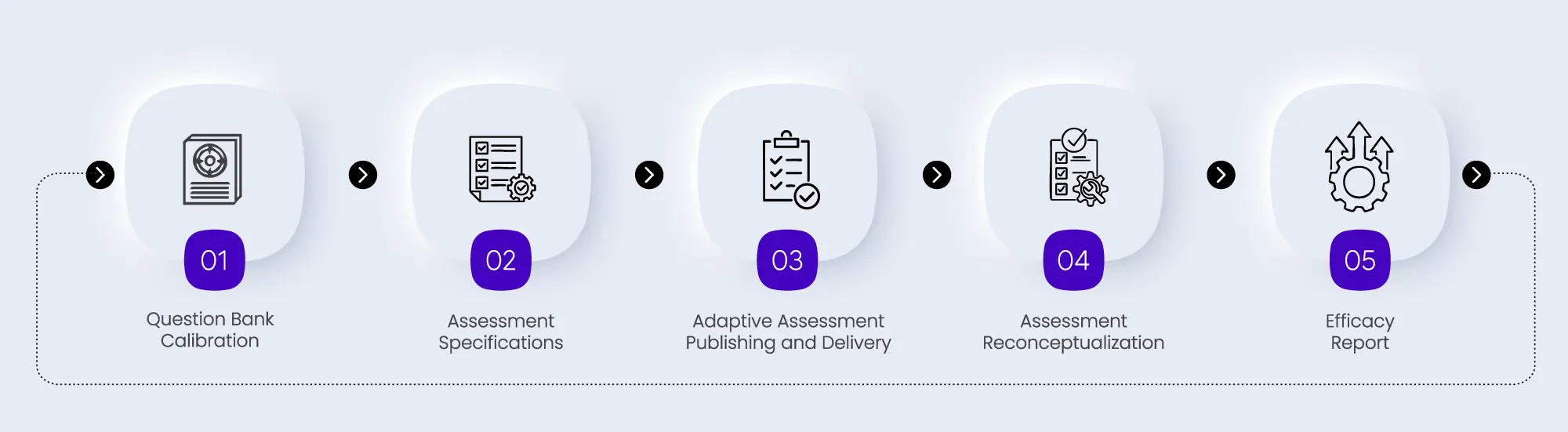
Magic EdTech’s 5-Stage Adaptive Assessments Framework
We typically follow a structured, five-stage approach to make adaptive testing operational. Each stage is designed to protect validity while improving efficiency. It turns your goals, blueprints, and item bank into a governed, data-driven engine for smarter assessments.
Beyond Adaptive: End-to-End Assessment Services
You get more than just adaptive tests. As your assessment strategy evolves, we can also help with:
Item development and review
Assessment design and blueprints

Assessment migration and consolidation

Accessibility and inclusive design
Analytics and reporting

IRT-3PL With AI-Supported Insights
Magic’s adaptive assessment framework is aligned to Item Response Theory (IRT). We incorporate models such as the Three-Parameter Logistic (3PL) where appropriate.
Over time, our AI-supported analytics help you:
- Find weak or drifting items faster
- See where your pool is thin and needs new content
- Understand how routing affects different cohorts
The result is an engine that delivers decision-ready scores with fewer questions and clearer insight into your bank.
We make upgrading your assessments feel effortless.
You don’t have to rebuild everything to go adaptive.
Modernize what you have
Keep your existing platform while we plug in adaptive logic, scoring, and analytics through APIs. Our team migrates your item bank so it’s “adaptive-ready”.
Or build something new
If you’re launching a new test or program, we help you design the adaptive experience from scratch.

Who We Work With
We work with educational institutions, publishers, and edtech companies and have been responsible for bringing some of their largest learning initiatives to fruition.




Case Studies

Adaptive Assessment for a Test Prep EdTech Player
- 200+ questions ingested via bulk upload
- 3PL IRT adaptive engine implemented

Driving Platform Adoption with High-Quality Assessment Migration
- 4000+ assessment items migrated
- <3% rejection rate achieved

Large-Scale Math Assessment Development for a Global K–8 Platform
- 8,250 math items delivered on time
- 0 post-QA defects across regions
Frequently Asked Questions
Our computer adaptive testing engine uses an adaptive algorithm that updates its estimate of a test taker’s ability after each student’s response. It then selects the next test item and questions based on difficulty level and your blueprint rules so it can accurately measure student performance and give better insight into student learning with the fewest questions.
Yes. Most clients keep their existing computer-based assessment platform, and we connect the adaptive logic, scoring, and analytics on top through APIs and standards-based integrations.
You can configure routing rules, starting points, test length, stopping conditions, content constraints, and reporting views for different ways of assessing students across programs. We work with your internal teams to align these with your psychometric model and policies.
The framework is designed for high concurrency and large item pools. We share architecture options and performance benchmarks during scoping so you can see how it behaves under real workloads.
We design interfaces to be accessible and usable with assistive technologies and align data practices with common education security and privacy expectations (for example, FERPA contexts). We also support unique item sequences for each candidate to improve test security.
We can help you set up dashboards and reports to track exposure, blueprint coverage, and subgroup performance, and to flag test items for review where fairness or performance needs investigation.