
Enrollment Pressure Is a Data Problem First
- Published on: March 25, 2026
- Updated on: March 30, 2026
- Reading Time: 5 mins
-
Views
Enrollment Pressure and Financial Sensitivity
Where Institutional “Truth” Breaks Across the Student Lifecycle
Why Enrollment Pressure Often Reveals Data Gaps First
The Questions Leaders Need Enrollment Data Analytics to Answer
Why Enrollment Planning Often Moves Too Slowly
The Hidden Problem: Definition Drift in Enrollment Metrics
The Minimum Dataset Institutions Need for Enrollment Forecasting
Turning Student Data Into Action Across Recruitment, Retention, and Programs
Building an Education Data Strategy That Supports Faster Decisions
What Strong Enrollment Management Looks Like When Data Works
FAQs
Enrollment pressure across higher education is often discussed as a recruitment challenge. In practice, it frequently appears earlier as a data challenge. When institutional leaders need fast answers about recruitment performance, program demand, or retention risk, the difficulty is rarely the absence of data. The difficulty is assembling a reliable institutional view quickly enough to guide decisions.
Enrollment Pressure and Financial Sensitivity
Higher education leaders are operating in a moment of unusual enrollment sensitivity. Undergraduate enrollment reached 15.3 million students in Spring 2025. As institutions continue adjusting to this uneven recovery, recruitment cycles feel tighter across many programs.
At the same time, the financial picture remains closely tied to enrollment performance. According to the State Higher Education Executive Officers Association, FY2024 recorded the largest tuition revenue drop on record at 3.7%, highlighting how even modest enrollment shifts can influence institutional budgets.
This is why enrollment management decisions increasingly depend on fast institutional insight. Leaders want to know:
- Which recruitment efforts are producing enrollments
- Where applicants disengage in the pipeline
- Which programs are attracting sustained interest
- Which students may need early support
The questions themselves are familiar. What has changed is the speed at which institutions now need answers and the difficulty of assembling those answers across fragmented systems.
Where Institutional “Truth” Breaks Across the Student Lifecycle
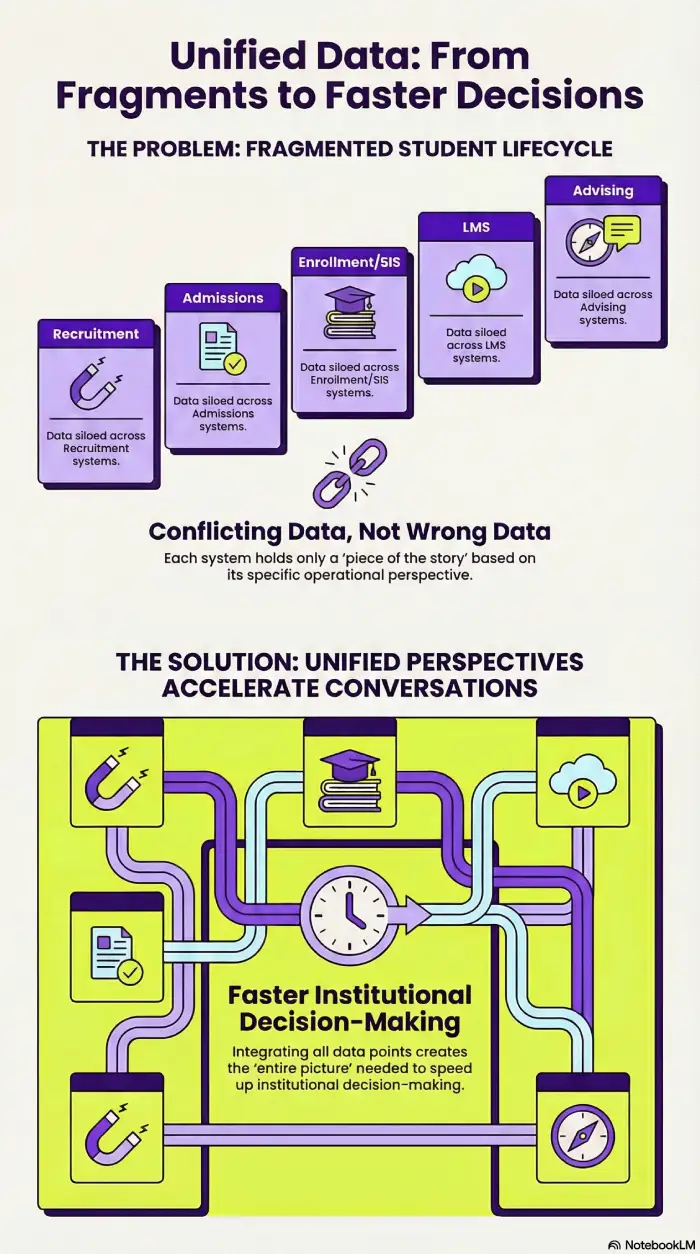
The difficulty often begins with how institutional systems are structured.
- Recruitment platforms track prospective students.
- Admissions systems manage applications.
- Enrollment management systems and SIS record official enrollment status.
- Learning management systems capture course engagement.
- Advising platforms track academic support activity.
Each system contains a piece of the institutional story. What it does not contain is the entire picture.
When leaders attempt to analyze student enrollment trends, different systems may report slightly different numbers. None of those numbers is necessarily wrong.
They simply reflect different operational perspectives. But the effect is the same: decision conversations slow down.
Why Enrollment Pressure Often Reveals Data Gaps First
Enrollment pressure does not create a data problem. It exposes one that already exists.
At first glance, it looks like institutions have everything they need, but all that data rarely lives in one place.
Federal reporting systems highlight the scale of institutional data collection. The U.S. Department of Education’s Integrated Postsecondary Education Data System (IPEDS) aggregates information from nearly 6,000 colleges and universities.
The challenge is not data availability. It is data alignment. Each system captures a different part of the student journey, often with different structures, definitions, and update cycles.
When enrollment pressure increases, leaders often discover that answering a seemingly simple question, such as where applicants disengage or which programs are attracting interest, requires connecting data across several systems. That delay in assembling a clear institutional picture becomes the real constraint.
The Questions Leaders Need Enrollment Data Analytics to Answer
Once systems begin operating independently, answering even basic enrollment questions becomes harder.
Leaders are often trying to understand things like:
- Which recruitment channels are producing committed students
- How applications are converting into confirmed enrollments
- Whether certain programs are gaining or losing interest
- Which early signals suggest a student may struggle to persist
Each of these questions pulls information from multiple sources.
Recruitment platforms hold one set of signals. Admissions systems hold another. Academic records and engagement data add additional context.
Without integrated enrollment data analytics, those signals remain scattered. Institutions end up working with partial views rather than a complete picture of enrollment activity.
Why Enrollment Planning Often Moves Too Slowly
The effects of disconnected data often become most visible during planning. Enrollment strategy requires coordination across recruitment, academic programs, and institutional finance.
Leaders need to understand which programs are gaining interest, how admissions pipelines are converting, and where early signals of student disengagement may appear.
When data lives across multiple systems, answering these questions takes time. Teams may need to reconcile reports from admissions, student information systems, and academic platforms before reaching a shared view.
That delay affects planning cycles. Recruitment teams may struggle to adjust outreach strategies mid-cycle. Academic leaders may not see shifts in program demand early enough to respond. Finance teams may have limited visibility into emerging enrollment patterns when forecasting tuition revenue. The challenge is rarely a lack of data. It is the time required to bring the right data together.
The Hidden Problem: Definition Drift in Enrollment Metrics
Another issue appears once multiple systems are involved: definitions begin to drift. Institutions may encounter different interpretations of:
- Official enrollment dates
- Retention measurement timelines
- Yield rate calculations
- Census reporting rules
At first, these differences seem minor. Over time, they accumulate. Eventually, leadership dashboards begin to show conflicting metrics depending on the report being used. This is where data governance becomes essential. Shared definitions and transparent reporting standards help ensure that enrollment analytics reflect a consistent institutional view.
The Minimum Dataset Institutions Need for Enrollment Forecasting
Improving enrollment insight does not require integrating every institutional dataset at once. Most institutions benefit from starting with a smaller decision dataset that combines the most important lifecycle signals. These often include:
- Recruitment pipeline activity
- Admissions funnel conversion rates
- Enrollment confirmations
- Early engagement indicators
- Program demand patterns
- Tuition and financial aid signals
When these datasets come together, institutions can begin building more reliable enrollment forecasting models. These models increasingly rely on predictive analytics to identify patterns in historical student data.
Turning Student Data Into Action Across Recruitment, Retention, and Programs
Integrated student data analytics becomes valuable when it supports operational action. Recruitment teams can refine student recruitment strategies during active cycles. Advising teams can monitor engagement indicators that suggest a student may need additional support. Academic leaders can track student enrollment trends across programs and adjust planning accordingly.
Finance teams benefit as well. When enrollment signals become clearer earlier in the cycle, budget forecasting improves. The objective is not simply better reporting. It is a faster institutional response.
Building an Education Data Strategy That Supports Faster Decisions
Many institutions are now building a more structured education data strategy to support enrollment decisions. Typically, this involves:
- Integrating recruitment, SIS, and learning platforms
- Standardizing institutional definitions
- Creating shared analytics environments
- Strengthening education analytics across departments
Platforms such as Magic EdTech’s EdDataHub help institutions bring these systems together within governed analytics environments. When recruitment, academic, and operational datasets become easier to access, institutions gain clearer visibility across the student lifecycle.
What Strong Enrollment Management Looks Like When Data Works
When institutional data systems operate cohesively, decision conversations change. Teams spend less time reconciling reports and more time interpreting signals. Recruitment strategies adapt more quickly to demand shifts. Program leaders gain earlier visibility into student interest. Advising teams can intervene sooner when engagement declines.
Over time, stronger data infrastructure allows institutions to move from reactive reporting toward proactive planning. In that environment, enrollment management becomes less about chasing numbers and more about understanding the full story behind them.

Harish is a future-focused product and technology leader with 25+ years of experience building intelligent systems that align innovation with business strategy. He drives large-scale transformation with cloud, data, and AI, leading agentic AI frameworks, scalable SaaS platforms, and outcome-driven product portfolios across global markets.
FAQs
Buying more ads expands your funnel. It cannot fix a broken data pipeline. If your internal systems do not communicate with each other, you will lose those newly acquired learners to silent attrition. You need infrastructure that supports them from day one.
The biggest disconnects are between the CRM, the SIS, and the LMS. There can be totally different definitions of the same learner by the admissions team, the registrars, and the academics.
Good governance creates a single source of truth. It ensures the CFO and the Provost are looking at the exact same numbers. This ends endless reconciliation battles. You stop arguing over spreadsheets and start executing your strategy.
It integrates your scattered information into one seamless predictive layer. This centralized view flags at-risk learners early. You can finally offer proactive advising exactly when it matters most.

Get In Touch
Reach out to our team with your question and our representatives will get back to you within 24 working hours.