
Why AI Governance for EdTech Publishers Matters More than Features
- Published on: January 28, 2026
- Updated on: June 29, 2026
- Reading Time: 6 mins
-
Views
Data Goldmines Don’t Solve Trust Gaps
2026 EdTech Is Moving Toward Transparency and Controllability
What “AI Governance” Looks Like in a Product
1. It Constrains What the Model Can Draw From
2. It Checks Outputs Against Educational Requirements
3. It Controls Behavior Based on Context
4. It Logs the Prerequisites for Audit and Troubleshooting
A Simple Example: Lesson Summaries
How to Build Governance Without Turning It into a Long Project
Start with the Use Cases That Matter Most
Define “Good Output” Before Scaling
Build an Evaluation Loop into Your Workflow
Add Transparency in a Way Procurement Can Understand
The Point Isn’t “Less AI.” It’s Better AI
Where Magic EdTech Helps
FAQs
Generative AI has moved fast in education. Most product roadmaps now include some combination of automated lesson support, content generation, question creation, tutoring-style chat, or educator workflows. That pace is understandable. EdTech decision-makers are asking about AI in EdTech and publishing in every conversation, and nobody wants to look behind.
But there’s a difference between adding AI and adding AI that can be trusted in a learning context. This is where AI governance for EdTech publishers becomes essential.
In education, trust is not an abstract brand concept. It shows up in very practical ways: whether instructors feel comfortable using a feature, whether institutions approve it, whether support tickets spike after release, and whether a product can hold up under scrutiny when something goes wrong.
This is where many teams run into the same wall. They keep shipping features, but adoption stalls because the underlying AI behavior isn’t reliable enough for real learning use cases.
Data Goldmines Don’t Solve Trust Gaps in EdTech AI
Education publishers and learning platforms have valuable assets: curriculum content, assessment items, standards mappings, teacher guides, rubrics, and years of usage and performance signals. On paper, it looks like the perfect foundation for AI.
In practice, even when teams integrate that data, they still face a trust gap because the model’s behavior is not inherently aligned to education.
Generic large language models don’t naturally understand things like:
- What it means to stay within an intended level of Bloom’s Taxonomy
- How to respect reading-level constraints and keep language grade-appropriate
- How to follow the instructional tone and “voice” that users expect from trusted materials
- How to scaffold learning rather than shortcut it
- How to behave differently in a study-support context versus an assessment-adjacent context
These aren’t minor details. They’re the difference between a feature that helps and a feature that creates risk.
A fluent answer that is slightly too advanced, slightly off-tone, or subtly incorrect can still look “good” at a glance. That’s exactly why governance matters. Without it, problems don’t always announce themselves. They slip through quietly and erode trust over time.
2026 EdTech Is Moving Toward Responsible AI in Education
The last two years spoke mostly about capability. Every product leader was testing out what AI can generate, how fast, and in what formats.
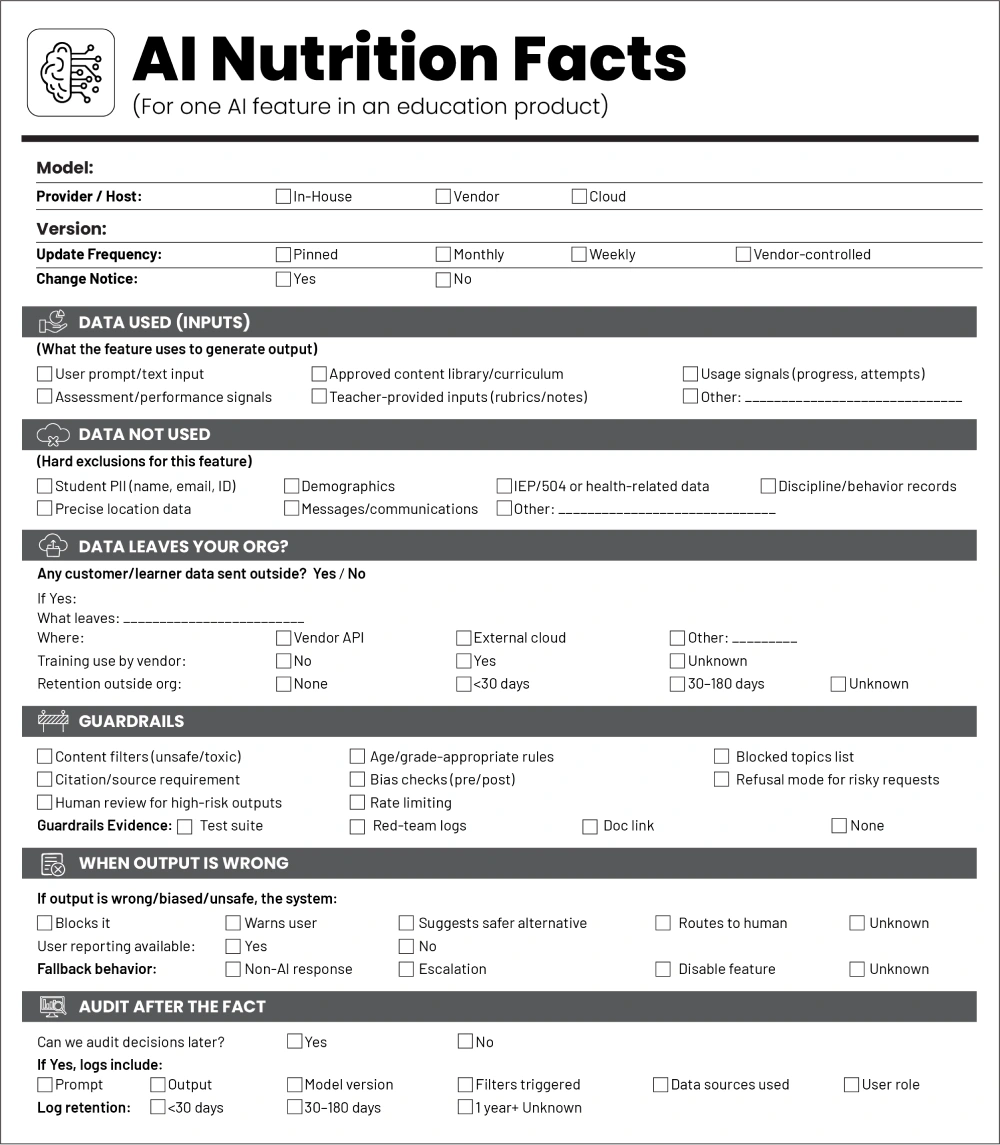
Now, all the questions I hear center around accountability:
- What model is being used, and how often does it change?
- What data is used in generation, and what data is excluded?
- Is any customer or learner data sent outside the organization for processing?
- What guardrails are applied, and can they be demonstrated?
- What happens when the output is wrong, biased, unsafe, or inappropriate for the learner?
- Can we audit decisions after the fact?
Many institutions want those answers in a simple, consistent format. Some teams have started describing this as an “AI nutrition label” for each feature, meaning a plain-language disclosure of how the feature works, what it uses, what it logs, and where its limits are.
At the same time, regulatory expectations are becoming stricter for higher-risk AI systems, particularly those used in sensitive contexts like education. That makes transparency and documentation more than a procurement preference. It becomes part of operating responsibly.
None of this is meant to slow innovation. It’s meant to make adoption possible at scale.
What “AI Governance” Should Look Like in a Product
When people hear “governance,” they sometimes think of committees and documents. That’s not what I mean here.
In product terms, governance is a working layer that sits between the model and the user experience and enforces the rules that matter in education.
You can call it an integrity layer, an AI governance layer for EdTech, or simply “the control plane.” The name matters less than the function.
In practice, this layer does four things consistently:
1. It Constrains What the Model Can Draw From
If a feature is supposed to respond using approved curriculum or an institution’s content, governance defines what sources are allowed and how retrieval works. It also limits what the model can do when it doesn’t have enough information, instead of letting it improvise.
2. It Checks Outputs Against Educational Requirements
This is where standards alignment, Bloom’s depth, reading-level boundaries, tone rules, and safety constraints are applied. In many cases, the system should not only evaluate output, but also revise it when it fails. This level of EdTech AI output governance helps reduce instructional and compliance risks.
3. It Controls Behavior Based on Context
Education use cases aren’t all equal. A student support feature needs different controls than a teacher content drafting tool. A tool used near assessment requires stricter safeguards than one used for brainstorming.
4. It Logs the Prerequisites for Audit and Troubleshooting
You need to be able to answer “what happened” later: what prompt was used, what model/version responded, what content was retrieved, what checks ran, what failed, what was revised, and what was shown to the user.
All these points are how you move from AI that generates content to AI that can be trusted.
A Simple Example: Lesson Summaries
Let’s take something common: generating lesson summaries.
Without governance, you often get outputs that sound fine but miss key expectations. A summary might be too advanced, skip foundational concepts, introduce subtle inaccuracies, or drift away from the tone educators expect.
With a governance layer:
- The system knows the intended grade and learning objective
- It generates a draft using approved sources
- It evaluates that draft against readability and instructional rules
- It revises or blocks outputs that fail
- It logs the checks and the final result
That’s not over-engineering. That’s what it takes to ship a feature that educators and institutions will actually adopt.
How to Start Building Governance Without Turning It into a Year-Long Project
Start with the Use Cases That Matter Most
Separate student-facing use cases from internal workflows. Start with the highest-risk, highest-visibility features.
Define “Good Output” Before You Scale
For each feature, write down the rules that matter. In education, that often includes reading level, tone, standards alignment expectations, and the allowed type of help.
Build an Evaluation Loop into Your Workflow
Make evaluation a part of how you develop, test, and monitor. Over time, you’ll want to track patterns: what fails, where drift happens, and what needs tighter controls.
Add Transparency in a Way Procurement Can Understand
Whether you use a formal label or a simple disclosure page, make it easy to answer the standard questions: model, data handling, guardrails, logging, retention, and limitations.
This is how governance becomes a product capability rather than a compliance afterthought.
The Point Isn’t “Less AI.” It’s Better AI
Education publishers need AI that behaves according to educational expectations. It must be consistent, level-appropriate, aligned to learning goals, safe, and explainable. And that’s what governance enables. Give your product team a structure that makes AI features reliable enough to scale.
Where Magic EdTech Helps
At Magic EdTech, we work with education product teams to design and implement these governance layers, including evaluation rubrics, orchestration controls, and the logging and transparency needed for institutional trust. Our work supports responsible AI in education while helping teams reduce the AI trust gap EdTech organizations increasingly face.
If you’re building new AI capabilities or trying to stabilize existing ones, get an AI governance audit. Identify your riskiest use cases, document current controls, and define what needs to be added to close the trust gap.
Ready to pressure-test your AI features against real instructional expectations? Learn how educational data services can help support more informed, reliable, and effective AI-driven learning experiences.

Harish is a future-focused product and technology leader with 25+ years of experience building intelligent systems that align innovation with business strategy. He drives large-scale transformation with cloud, data, and AI, leading agentic AI frameworks, scalable SaaS platforms, and outcome-driven product portfolios across global markets.
FAQs
An AI governance layer for an EdTech publisher should define what “acceptable” means (standards, reading levels, tone). Enforce them through validation, logging, and controlled release. If you can’t explain why an output is allowed, you can’t earn trust at scale.
Automate what you can: standard checks, regression tests, and sampling plans that run as part of CI for AI features. Save human review for high-risk content, edge cases, and policy exceptions, where judgment adds real value. This approach supports responsible AI in education without slowing product velocity.
They bolt on policy statements instead of building enforceable controls. If governance isn’t part of the data flow (logging, access control, evaluation gates, exception handling), it won’t hold up under real classroom and procurement scrutiny. That’s where many organizations experience the growing AI trust gap in EdTech.
The product teams should bring in support when their requirements span pedagogy, data architecture, compliance, and they need a single workflow that ties them together. Teams often work with Magic EdTech when they want to design evaluation rubrics, build repeatable checks, and integrate governance into delivery without turning it into a one-off manual process.

Get In Touch
Reach out to our team with your question and our representatives will get back to you within 24 working hours.