
AI-Native Content Transformation: How Static Content Becomes Modular Learning Assets
- Published on: July 21, 2026
- Updated on: August 20, 2026
- Reading Time: 8 mins
-
Views
What is a Modular Learning Asset?
What a Reusable Learning Asset Should Carry
How AI-Native Content Transformation Works
1. Ingest the Source Without Stripping Away Its Context
2. Reconstruct the Instructional Structure
3. Break the Content into Meaningful Learning Units
4. Connect Each Object to a Learning Objective
5. Apply Metadata, Taxonomy, and Asset Relationships
6. Review, Approve, and Version the Assets
7. Prepare the Assets for Downstream Use
Why the Relationship Map Matters as Much as the Content
AI Does the Heavy Lifting. People Protect the Learning Intent
Where ezSuite Fits into the AI Content Transformation Workflow
FAQs
For publishers and edtech companies, creating content is rarely the hardest problem to solve.
In our previous blog, we made the case that static content repositories have become a constraint on product development, personalization, and AI readiness. We also looked at why the larger opportunity for AI lies in transforming existing intellectual property, not simply generating more content.
What happens between uploading a legacy textbook or course archive and receiving modular learning assets that a product team can use? This blog takes a look at the mechanics behind that process. We will explore how an AI-native content transformation workflow preserves instructional meaning while adding the structure needed for future reuse.
But before we get into that, there are a few concepts we must clarify first.
What is a Modular Learning Asset?
One of the easiest mistakes in content modernization is to confuse content splitting with modularization.
Sure, a video can be cut into three-minute segments, or you can separate a chapter into paragraphs. Technically, the content is now smaller, but instructionally, it may be less useful than before.
A modular learning asset must therefore be:
- Small enough to reuse
- Complete enough to make sense
- Connected to a defined learning purpose
- Traceable to its original source
- Structured so that teams and systems know where it belongs
The useful unit is not determined by page length, file size, or token count, but by instructional meaning.
Semantic chunking is a central part of AI content transformation. Instead of breaking content at arbitrary technical boundaries, semantic chunking identifies where one teachable idea ends, and another begins.
What a Reusable Learning Asset Should Carry
To explain this better, let’s take an example of any paragraph within a large textbook chapter. On its own, the paragraph is simply a snippet. But it becomes a reusable learning asset when the organization can answer several questions about it.
| Asset property | Question it answers |
| Instructional role | Is this an explanation, example, practice activity, assessment item, remediation resource, or summary? |
| Learning objective | What should the learner know or be able to do after using it? |
| Source traceability | Where did it come from, and which approved source supports it? |
| Context | What should the learner encounter before or after it? |
| Metadata | What subject, audience, difficulty, language, format, and topic does it belong to? |
| Content taxonomy or standards alignment | Where does it fit within the organization’s approved structure? |
| Asset relationships | What other assets explain, demonstrate, assess, remediate, or extend the same concept? |
| Review status | Has it been reviewed, approved, revised, or retired? |
| Version information | Which version is current, and what changed? |
| Permitted uses | Can it support a course, assessment, adaptive pathway, localized variant, or other learning product? |
Without this surrounding structure, your team may have smaller content, but not more usable content.

How AI-Native Content Transformation Works
An AI-native workflow treats content transformation as an architectural process. AI is used throughout the workflow to interpret, structure, enrich, and connect content, rather than being added only at the final generation stage.
The exact workflow will vary by repository and product requirement, but the core stages are generally consistent.
1. Ingest the Source Without Stripping Away Its Context
The first stage is to process the source material.
That source may include:
- Textbooks and PDFs
- Course archives
- Instructor materials
- Presentations
- Recorded lectures or training videos
- Item banks
- Knowledge bases
- Syllabi and curriculum documents
Because source traceability begins at ingestion, the workflow should retain the headings, sections, tables, captions, media references, question structures, page locations, timestamps, and other source relationships.
When an asset is created later, a reviewer should be able to identify its source. Without that connection, teams may struggle to verify accuracy, review changes, or determine which downstream assets are affected when the source is updated.
Output of this stage: A machine-readable version of the source that retains its structural and location information.
2. Reconstruct the Instructional Structure
Legacy files often store content visually rather than semantically.
A human reader can usually recognize that one paragraph defines a concept, the next provides an example, and a callout box warns against a common misconception. Most content systems only see text blocks, page coordinates, or file elements.
AI can help identify important instructional components, such as definitions or practice activities, to help develop an instructional map of the source.
The workflow preserves sequences where they matter. An explanation, visual model, and worked example may be separate content objects, but the system should still know that they form a coherent teaching sequence.
Output of this stage: A structured map showing what each section does instructionally.
3. Break the Content into Meaningful Learning Units
Once the instructional structure is understood, the content can be divided into candidate learning objects.
This is where semantic chunking differs from ordinary file splitting.
A semantic chunk should represent one coherent unit of meaning. It might be:
- A definition of one concept
- A worked example demonstrating one procedure
- A short explanation addressing one misconception
- A video segment focused on one skill
- A practice activity tied to one objective
- An assessment item measuring one outcome
The boundary should be determined by what the asset teaches, not by how much text fits into it.
Output of this stage: Candidate learning objects with preserved relationships and source references.
4. Connect Each Object to a Learning Objective
Learning-objective alignment is what prevents modularization from becoming random fragmentation. Each candidate asset should have a clear instructional purpose. Depending on the content, the workflow may identify the primary or supporting learning objectives. AI, which has been built and vetted by subject domain experts in education, can be trained to suggest these relationships by examining the content and the organization’s approved frameworks. Curriculum specialists, instructional designers, or subject matter experts can then further confirm or adjust them.
This step is important because the learning objective becomes one of the primary ways the asset can be found and reused.
A product team should be able to ask, “Which approved assets help learners understand equivalent fractions?” rather than search through filenames, chapter numbers, or old course folders.
Output of this stage: Learning objects with an explicit and reviewable instructional purpose.
5. Apply Metadata, Taxonomy, and Asset Relationships
Learning object metadata makes the asset discoverable. Relationships make it usable.
A content object may be tagged by:
- Subject
- Topic
- Skill
- Audience
- Grade or proficiency level
- Difficulty
- Asset type
- Format
- Language
- Locale
- Learning objective
- Standard or competency
- Review status
The workflow should also describe how assets relate to one another.
For example:
- This asset explains a concept.
- This worked example demonstrates the concept.
- This practice item applies the concept.
- This assessment item measures the objective.
- This resource remediates a common misconception.
- This advanced example extends the concept.
- This prerequisite asset should precede the lesson.
These relationships create a connected content model rather than a flat asset library.
Output of this stage: Discoverable learning assets connected through an approved content structure.
6. Review, Approve, and Version the Assets
AI can propose content boundaries, metadata, objectives, relationships, and derivative outputs. It should not silently make every instructional decision.
Human review remains important where a decision affects:
- Source fidelity
- Instructional completeness
- Curriculum intent
- Standards alignment
- Assessment validity
- Accessibility
- Learner appropriateness
The goal is to route decisions with instructional or product risk to the people qualified to make them.
Each object should carry a clear status, such as:
- Draft
- AI processed
- Needs specialist review
- Approved
- Revision required
- Retired
Version history should also be preserved so teams know which object is current and which products use it.
Output of this stage: Approved, traceable, and version-controlled learning assets.
7. Prepare the Assets for Downstream Use
A modular asset only creates value when it can move into the systems and products that need it. The final transformation stage prepares assets for downstream environments such as:
- Learning management systems
- Authoring tools
- Item banks
- Assessment platforms
- Adaptive learning systems
- Localization workflows
- Analytics environments
- AI-supported tutoring or discovery tools
The object’s identity, objective, metadata, source, relationships, and review status should remain connected during this process.
Otherwise, teams end up creating disconnected copies whenever content moves into a new product, defeating the purpose of modularization.
Output of this stage: Learning assets that are ready to be assembled, delivered, measured, and updated across products.
Why the Relationship Map Matters as Much as the Content
Modern learning products need more than a collection of assets. They need the relationships surrounding those assets.
A useful relationship chain goes from source to concept to learning objective, all the way to learner signals.
When that chain remains intact, several useful things become possible.
- If a source explanation changes, the team can identify which learning objects and product variants may need review.
- If learners repeatedly miss an assessment item, the product can connect that result to the relevant objective, prerequisite, explanation, or remediation asset.
- If a course is localized, teams can identify which translated assets inherit meaning from the same approved source.
- If a reviewer questions an AI-generated output, the asset can be traced back to the source and transformation decision that produced it.
This is why AI-native content transformation is better understood as content architecture than file conversion.
The final output is a connected system that describes what the content teaches, where it came from, how it may be used, and what other assets it affects.
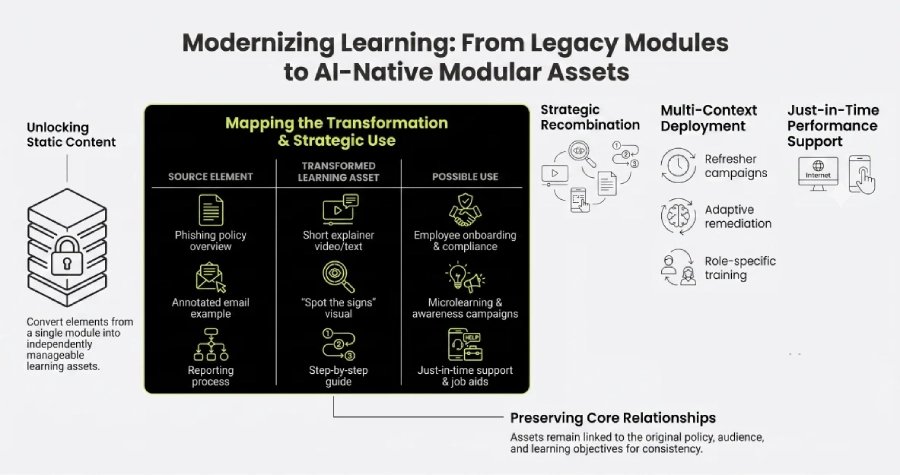
As an example, a legacy cybersecurity training module on phishing. An AI-native content transformation workflow would break down this monolithic course into connected but independently manageable learning assets.
From One Training Module to Multiple Learning Experiences
This infographic illustrates how the individual elements of a static legacy training module are broken down and transformed into distinct, modular learning assets. It maps each original component to its new format and highlights the flexible ways these standalone assets can now be used across different learning scenarios.
AI Does the Heavy Lifting. People Protect the Learning Intent.
AI can significantly accelerate the mechanical and analytical parts of learning content transformation.
People remain responsible for decisions where context matters.
Instructional designers determine whether an object teaches effectively. Curriculum specialists validate alignment. Assessment experts determine whether an item measures what it is intended to measure. Accessibility specialists confirm that visual and interactive meaning has been preserved.
The useful division of labor is straightforward:
AI proposes and processes. Experts validate and approve.
That approach allows teams to automate substantial parts of the workflow without treating plausible output as production-ready content.
Where ezSuite Fits into the AI Content Transformation Workflow
ezSuite is designed around this connected model of AI-based content transformation.
It can work with source material such as long-form documents, curriculum structures, recorded content, standards or competency frameworks, assessment inventories, and knowledge bases. Its AI-native core supports content modularization, learning-objective alignment, metadata, taxonomy, skills, and standards mapping, while the resulting assets can support outputs such as micro-lessons, courses, assessments, adaptive learning experiences, and localized variants. Subject matter experts remain part of the approval process before assets are published.
The objective is not simply to generate another lesson from a source file. It is to create a structured set of learning objects that teams can review, govern, assemble, and use across future learning products.

Sudeep has 20+ years of experience partnering with global corporations to drive growth through human capital and technology efficiency, leading large-scale EdTech and L&D transformations, workforce solutions, and AI-driven learning initiatives across complex enterprise ecosystems.
FAQs
A modular learning asset is an independently manageable content object with a clear instructional purpose. It carries information such as its learning objective, source, metadata, relationships, review status, and potential uses. Examples include explanations, worked examples, practice activities, assessment items, video segments, and remediation resources.
Page-based or length-based splitting uses technical boundaries. Semantic chunking uses meaning and instructional purpose. It attempts to keep a complete concept, explanation, example, or activity together while preserving its relationships with surrounding content.
Transformation workflows can begin with textbooks, PDFs, videos, presentations, course archives, instructor materials, item banks, syllabi, assessment frameworks, and knowledge bases. The workflow may differ by format, but the objective remains the same: preserve meaning while adding structure and relationships.
Assets intended for instruction, practice, assessment, or remediation should be connected to a defined learning purpose. Some supporting assets may inherit an objective from a parent object, but the relationship should still be clear. Without it, teams may struggle to determine where the asset belongs or whether it is appropriate for reuse.
Source traceability allows reviewers to verify accuracy, understand how an asset was produced, and identify affected outputs when source material changes. It also helps teams distinguish approved learning content from unverified or disconnected AI-generated material.
Yes, provided the asset is instructionally complete, appropriately tagged, traceable, and prepared for the relevant product requirements. The same explanation or worked example might support a course, microlearning module, remediation pathway, practice experience, localized variant, or AI-supported learning tool.
Yes. AI can accelerate extraction, classification, chunking, tagging, mapping, and generation. Human specialists remain important for validating instructional meaning, curriculum intent, standards alignment, assessment quality, accessibility, and final approval.

Get In Touch
Reach out to our team with your question and our representatives will get back to you within 24 working hours.