
AI Localization for Educational Publishing: What Has to Survive Translation
- Published on: July 24, 2026
- Updated on: October 15, 2026
- Reading Time: 6 mins
-
Views

Why Formatting Breaks in AI Book Localization
How HTML Tags Preserve Formatting in Multilingual Educational Content
Where the Translation API Fits
Choosing AI Models for Educational Content Localization
Translation Memory and Terminology Controls for Educational Publishers
Where Human Review Fits in Educational Content Localization
Five Production Checks for AI Localization in Educational Publishing
1. How Is Formatting Represented?
2. Which Language Behaviors Are in Scope?
3. How Will Models Be Selected?
4. Where Can Authors Intervene?
5. What Happens After the Translation Response?
Preserving AI-Localized Content Through Publishing and Delivery
Building an End-to-End AI Localization Workflow for Educational Publishing
FAQs
In educational publishing, “ready” depends on who is looking at the title. Engineering may see a completed translation request. An author may see wording that reads correctly. Publishing still has to confirm that the approved content survives layout and delivery. The gaps between those checkpoints are where correction work accumulates.
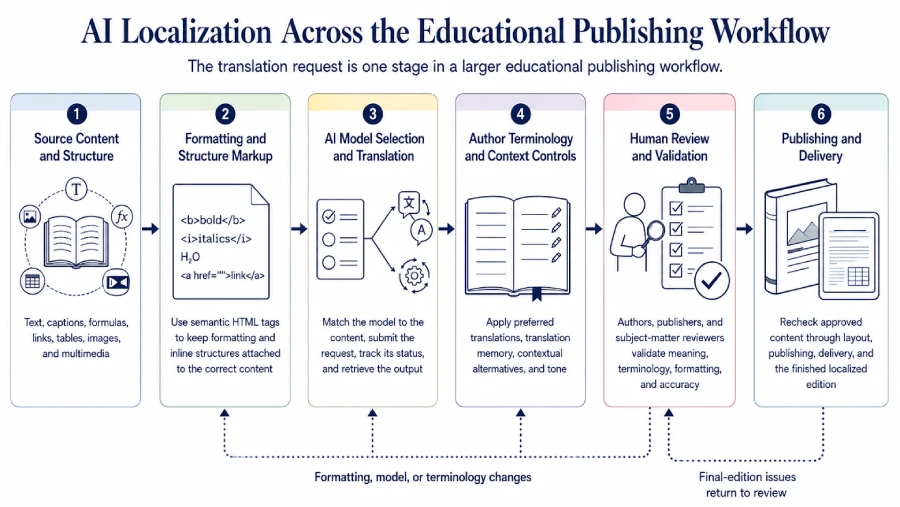
I assess AI localization by following content through that full path. I look at how formatting is represented, where authors can control terminology, how review is planned, and whether approved content remains intact as it moves between systems and teams.
This article sets out the production checks my team & I use to judge whether AI-localized educational content is ready for production, with particular attention to the work that remains after the translation response.
The workflow below maps those checkpoints from source content through publishing and delivery.
Why Formatting Breaks in AI Book Localization
In educational content, formatting is part of the content structure. A page may combine running text with:
- Bold and italic styling
- Superscripts and subscripts
- Chemical formulas and mathematical expressions
- Tables, captions, and footnotes
- Hyperlinks
- Image captions and video subtitles
During localization, each element has to remain connected to the correct word, phrase, or object.
When formatting is stored as start and end character positions, those positions become unreliable after translation. Sentences expand, contract, or reorder, and the original indexes may point to different content.
For example, in one multilingual publishing workflow, bold styling sometimes extended into the next word or disappeared, and some passages lost text altogether. Korean and Japanese made the change in character positions particularly visible, while Urdu introduced right-to-left handling.
The translated wording could be clear while the page still required substantial correction. That made formatting preservation a production requirement rather than a final visual check.
How HTML Tags Preserve Formatting in Multilingual Educational Content
Once a translated sentence changes length or order, formatting can no longer depend on its original character positions.
In the workflow discussed here, my team converted inline formatting into HTML tags before translation. The tags kept bold, italics, superscripts, subscripts, formulas, and links attached to the marked content instead of fixed positions in the source sentence.
HTML tags gave us a more stable way to carry that relationship through changes in sentence length and order. The output still required validation, particularly once it moved into publishing and delivery.
Where the Translation API Fits
The translation service used an asynchronous REST flow. A request included the target language, source text, and any custom instructions. It returned a task ID, which was then used to check the status and retrieve the translated output.
Before the request, the source content had to be structured correctly. After the response, the translated output had to be reconstructed without separating formatting from the words or elements it belonged to.
Choosing AI Models for Educational Content Localization
Educational books can move from text-heavy pages to pages containing captions, formulas, images, video, or several content structures. These differences affect the translation task and the amount of correction an author may have to do afterward.
At the request level, model selection can account for the amount of text, the presence of images or video, the mix of content structures, and the level of contextual handling required.
That routing can distinguish between:
- A baseline model for standard text
- A multimodal model for content containing images or video
- A context-focused model for more demanding passages
The amount of correction left for the author became the practical measure. A model that produced acceptable results for a text-heavy page did not automatically create the same review effort for a page containing captions, images, formulas, or multimedia.
I would therefore make model selection part of the content workflow rather than setting one default for every page and language.
Translation Memory and Terminology Controls for Educational Publishers
The same word can have several acceptable translations. The right choice may depend on whether the book uses formal or informal language, the region it is intended for, and the meaning of the surrounding passage.
Giving the model more context can improve the result, but education publishers also need a direct way to specify the wording they want.
Two practical author controls are a two-column Excel file containing a source term and preferred translation, and translation memory for choosing contextual alternatives when the first result does not fit the intended usage. These controls support decisions involving:
- Formal or informal language
- Preferred terminology
- Regional vocabulary
- Alternative meanings for the same word
- Wording suited to the educational context
These controls kept the final terminology decision with the author and allow preferred wording to be applied within the authoring process.
Where Human Review Fits in Educational Content Localization
Review belongs in the publishing schedule from the beginning because it affects both content quality and delivery time.
Authors need to check whether the translated passage expresses the intended meaning. Publishers need to review formatting and output quality. Subject-matter reviewers may still need to validate terminology, context, and conceptual accuracy.
In one workflow estimate, the complete cycle was expected to take up to 10 days. Three to four of those days were allocated to author and publisher review.
Keeping those days visible made the estimate more realistic. Automation reduced repetitive translation and development work, while the review period remained available for decisions that depended on knowledge of the content and its intended audience.
I would define who reviews each layer, how much time is reserved, and what must be approved before the edition moves forward.
Five Production Checks for AI Localization in Educational Publishing
I group the production review into five checks:
1. How Is Formatting Represented?
Identify whether inline styles are tied to character positions or stored in a structure that can remain connected to the content during translation.
2. Which Language Behaviors Are in Scope?
Account for changes in sentence length and order, non-Latin character sets, and right-to-left languages.
3. How Will Models Be Selected?
Consider text volume, media, paragraph structure, and contextual requirements before deciding which model should handle the request.
4. Where Can Authors Intervene?
Give authors a way to provide context, preferred terminology, and alternative wording without rebuilding the translated content manually.
5. What Happens After the Translation Response?
Define how the content will be reviewed and what must remain intact as it moves through authoring, publishing, and delivery.
Together, these checks connect the technical design with the work authors and publishers will still have to do. They also expose where a small issue in translation can create correction work later in publishing or delivery.
Preserving AI-Localized Content Through Publishing and Delivery
The quality of a localized edition can change after the translation has been returned. Formatting may shift during publishing. Spacing or line breaks may change. Content or context can be lost as it moves between different parts of the platform.
That makes the handoffs between teams part of the localization design. In one multilingual publishing implementation, separate teams supported authoring, the translation interface, publishing, and delivery, so the content had to remain intact as it moved between them.
During pre-production in that implementation, one author published Portuguese, Korean, and Japanese editions at the same time. The author described the text as clear, although review still took place at each layer. The process also reduced the author’s development effort, leaving more time for content creation.
For me, the useful measure is whether localized content can move through publishing while leaving the author with less repetitive correction work.
Building an End-to-End AI Localization Workflow for Educational Publishing
My experience with this work has led me to assess AI localization at the level of the finished edition. The translation response is one checkpoint. Formatting, model selection, terminology controls, review, publishing, and delivery all affect the work left for the author.
The content also has to remain intact as it moves between those parts, even when different teams own authoring, translation, publishing, and delivery.
At Magic EdTech, our ezSuite’s multilingual content delivery help educational publishers work across that complete workflow, from translation services and formatting preservation to author controls, review, publishing, and delivery.
The starting point is understanding what the content must retain at each handoff and where the current process creates avoidable manual work.
FAQs
AI-driven book localization involves the AI usage to localize educational content in different languages and geographical areas while retaining formatting, context, cultural sensitivity, and high publishing standards. It not only translates educational materials but localizes them for global distribution.
Artificial intelligence enables automated localization of content, formatting, and publishing of educational materials. The localization process using AI and human intervention may be reduced from several months to only 10 days.
Education-related books employ such formatting as bold, italic, formulae, subscript, superscript, tables, and captions to communicate. Preserving the formatting during localization ensures that all learners have an equal learning experience through all localizations.
Every kind of content calls for a different AI skillset. Multiple models provide publishers with the opportunity to choose the right model for standard text, multimedia, or context-rich education content to enhance localization quality while minimizing the amount of review required.
Not necessarily. AI speeds up the localization process but still requires SMEs, authors, and publishers to verify educational, terminological, and formatting accuracy of localized content.
Publishers can leverage the scalability of localization through a combination of AI-driven workflow, translation memory, terminology management, and HTML tag formatting preservation. Collaborating with an experienced EdTech localization vendor will be instrumental in minimizing risks during implementation and speeding content distribution.

Get In Touch
Reach out to our team with your question and our representatives will get back to you within 24 working hours.