
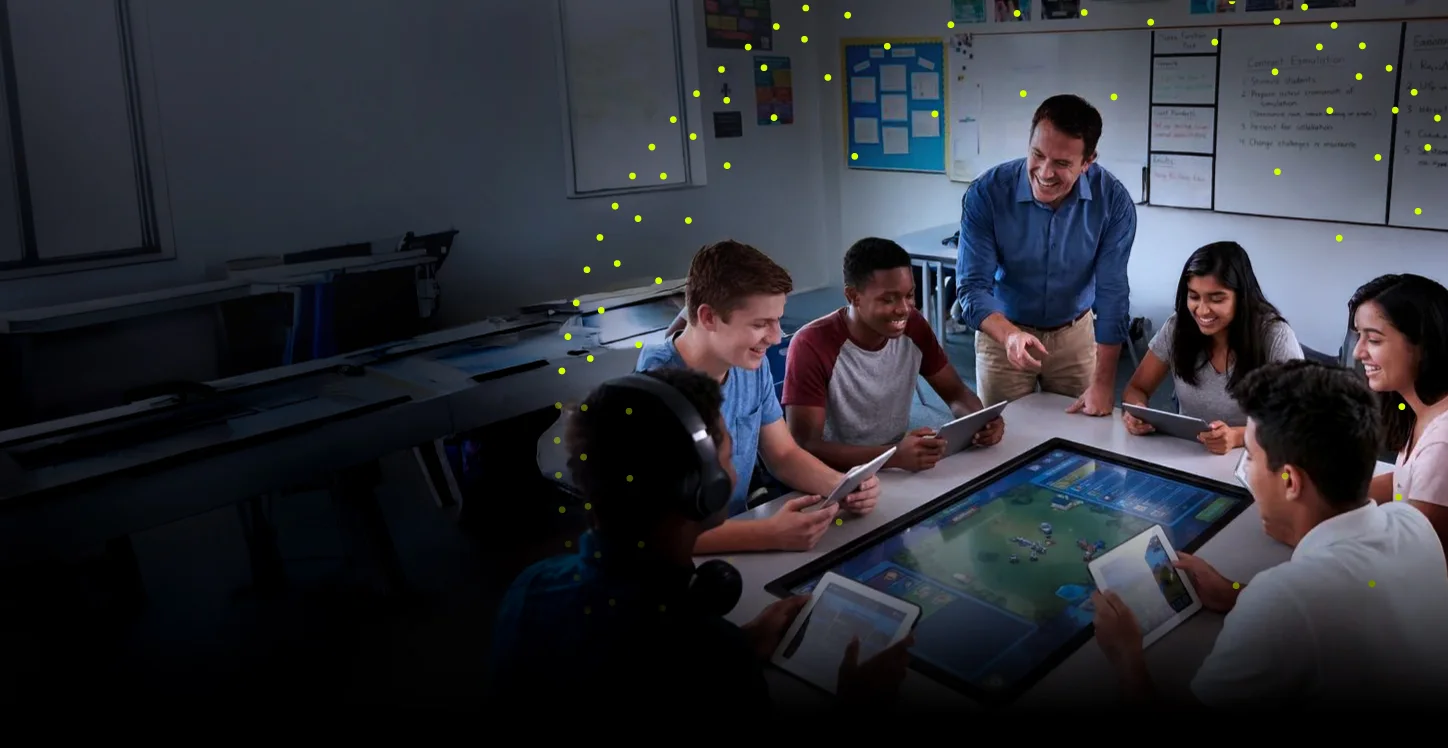
Build immersive learning experiences into products, curricula, and programs
Magic EdTech helps education organizations decide where immersive learning will improve practice and performance, then designs, builds, integrates, pilots, and scales it within real products and curricula.
Talk to Our Team-
 35+
35+Years in education
-
200+
Learning organizations served
-
600+
Diverse learning products


What We Offer
Our teams can take an initiative from discovery through design and rollout. Get a focused prototype, a multi-course content portfolio, or a standalone immersive learning platform built for a specific learner audience.
Large immersive projects usually begin with a curriculum gap, product requirement, adoption deadline, or performance problem.
Starting with a clear learning and business case, we assess learner needs, curriculum or product gaps, content volume, technical constraints, data requirements, and adoption conditions. Then we prioritize use cases, recommend the right immersive learning technology, and define a phased plan for prototyping, development, integration, validation, and rollout.
Give learners a safe place to practice decisions, procedures, experiments, and troubleshooting. We design and build browser-based and XR simulations and virtual labs with branching scenarios, feedback, and assessment. Reusable components and asset libraries can extend the work across grades, courses, modules, languages, and district or institutional deployments.
Explore our custom simsImprove engagement by making the learning task worth repeating. Our learning designers, game designers, artists, and Unity developers create complete educational games or add game mechanics to existing courseware. Story, challenge, progression, feedback, and assessment are designed around the knowledge or behavior learners need to develop.
Need to make your digital courseware more engaging? Our team includes instructional designers, graphic creators, technology experts, and specialists in engaging courseware design. We help you embed interactive learning objects and augmented reality into digital courseware for a more effective learning experience. Our courses are built with accessibility in mind to accommodate diverse learning preferences and abilities. We use customizable frameworks that speed up course deployment without straining budgets.
Build or extend the technology behind an immersive learning experience. We develop browser-based simulations and WebXR, mobile AR, and headset-based VR or mixed reality, then integrate the work with your LMS, product, assessment, analytics, and content workflows. The architecture is planned for performance, reuse, localization, accessibility, and ongoing release management.






Need more assessment capacity without new headcount?
Tell us where the pressure is: new item development, item-bank remediation, accessibility, localization, platform migration, practice-test creation, or ongoing operations. We will shape the engagement around your assessment purpose, specifications, review model, internal team, and timeline.

How we drive results
See what immersive learning solutions look like when they are tied to a product requirement, curriculum standard, or operational goal.

WebXR Emergency Responder Training for a CTE Platform
Magic designed and developed a real-time CPR and AED simulation in Unity for WebXR and Meta Quest, with a phased rollout across 10 EMR modules.
- Up to 15% lower production cost for future simulations through asset reuse
- Aligned with AHA and NREMT standards

Accessible Game Portfolio for a K-12 Curriculum Provider
A K-12 curriculum provider serving more than 10 million students across 20,000 US schools needed a new games portfolio.
- 30+ educational games developed
- Client reach of 10M+ students across 20,000 US schools

NGSS Science Simulations for State Adoption
A K-12 publisher preparing for a state science adoption needed virtual labs that were standards-aligned, scientifically accurate, and ready to scale.
- 35% reduction in development costs
- NGSS alignment designed for state-adoptions

Automotive Training Simulations Across Five Courses
A postsecondary technical institution with more than 220,000 graduates needed to turn automotive coursework into applied, repeatable practice.
- 35+ scenario sims and virtual labs delivered
- 40+ interactive animations across 5+ courses
The Magic EdTech Difference
Magic EdTech brings curriculum and learning design, experience design and engineering, accessibility, QA, and program leadership into one delivery team. This keeps the learning intent connected to product decisions.
An immersive learning solutions provider must do more than produce a polished demo. The work also has to survive curriculum and accessibility review, integrate with the LMS, meet procurement requirements, and work in real classrooms or training environments. We connect the build to the requirement behind it: a product gap, standards framework, course objective, adoption need, or competency. Learning designers and domain specialists work alongside engineers from discovery through QA, helping preserve instructional intent throughout implementation.
Experience a revolutionary approach to immersive content development with our AI-powered rapid development frameworks. By automating repetitive tasks in content development, our scalable frameworks empower instructional designers to focus on tasks directly related to meeting the learning objectives.
An immersive learning experience has to work inside the larger product. We plan feedback, assessment, event tracking, analytics, content workflows, and LMS or platform integration as part of the build. Your team can evaluate performance, product engagement, and pilot results before expanding the program.
Accessibility starts in discovery and storyboarding. Depending on the modality, we plan for keyboard and screen-reader access where applicable, captions, text and audio alternatives, motion and input options, and equivalent learning routes. Accessibility specialists and testers review the experience against the agreed requirements throughout development.
Large programs need clear scope, dependencies, quality gates, and release planning. Our project leads make budget drivers and delivery risks visible, while reusable interaction patterns, templates, components, and asset libraries can reduce repeat production. This supports expansion across courses, grades, languages, district and institutional deployments, and future releases.
Our ability to manage projects and communicate proactively sets us apart. With a track record of working with top publishers and EdTech companies, we understand the intricacies of the education domain and navigate them seamlessly. Our customers love the clarity we provide in pricing models and our transparent approach to budget management to help you plan effectively and avoid unexpected costs.

Immersive Learning Solutions by Segment

Publishing & EdTech
Strengthen an existing product or build a portfolio of simulations, labs, and games. We align each experience with your release roadmap.
Explore
Higher Ed Institutions
Create virtual labs, simulations, and course experiences for online, hybrid, and campus programs. We align them with course outcomes.
Explore
Workforce Learning
Give learners safe, repeatable practice with procedures, equipment, and high-stakes scenario-based training.
Explore
School Districts
Prepare standards-aligned experiences for adoption review or turn adopted or finalized curriculum into classroom-ready digital products.
Explore
Working with Olivia, Eric, and the team at Magic has been a great experience. They connected us with a wonderful group of SMEs and together we were able to complete our project on time and to a high standard. Throughout they have been responsive, and also proactive, and a pleasure to work with. We look forward to more opportunities to work with Magic in the future!

Immersive Learning Solutions by Segment
-
Education Publishers and EdTech Companies
Strengthen an existing product or build a portfolio of simulations, labs, and games. We align each experience with curriculum, assessment, platform requirements, and your release roadmap. -
School Districts and State Education Agencies
Prepare standards-aligned experiences for adoption review or turn adopted or finalized curriculum into classroom-ready digital products. We plan for teacher workflows, device conditions, accessibility, and district-wide deployment. -
Higher Education Institutions
Create virtual labs, simulations, and course experiences for online, hybrid, and campus programs. We align them with course outcomes, assessment, platform integration, and faculty use. -
Workforce and CTE Providers
Give learners safe, repeatable practice with procedures, equipment, and high-stakes decisions. We build scenario-based training that captures consistent practice and assessment data across sites.
Insights for Teams Building Learning Platforms

Plan Your Immersive Learning Project
Planning a new immersive learning platform, improving an existing product, or preparing curriculum for a major adoption cycle?
FAQs
Yes. We start with your learning goals, product strategy, audience, content, technical environment, and success criteria. From there, we identify where immersion will add meaningful value, recommend the right experience and technology, and define a phased roadmap covering prototypes, development, integration, validation, and rollout.
Yes. A new platform may not be required. We assess your current product, identify the highest-value opportunities, build the content or capability, and integrate it with existing product, content, assessment, analytics, and LMS workflows. We can also modernize legacy modules without replacing the full product.
We start with the action learners must perform and the environment in which they will use it. Browser simulations often provide the widest access. Games support repeated practice and feedback. AR connects digital guidance to physical settings. VR is useful when spatial presence or embodied procedure is central. Cost, access, safety, and scale also inform the choice.
Yes. We can map experiences to standards and scope and sequence requirements, incorporate assessment and instructional support, and plan for accessibility, devices, bandwidth, integrations, and implementation. Adoption readiness involves more than an alignment claim; the product must work within the conditions schools and districts will evaluate.
We define reusable content models, interaction patterns, assets, code, review criteria, and governance before scaling production. Work can be released in phases so curriculum, product, and technical teams can validate the approach early. This can reduce one-off development and improve the predictability of estimates, QA, maintenance, and future updates.
Before design, we agree on the learning or engagement measures and the baseline they will be compared against. We instrument attempts, choices, sequence, accuracy, time, hints, completion, and assessment results where appropriate. For a pilot, we can compare those signals with the existing experience or agreed success thresholds. Analytics can show patterns; outcome claims require a defined evaluation design.
Accessibility depends on the modality and cannot be added as a single compliance layer at the end. We consider keyboard and assistive-technology access where applicable, readable interfaces, captions and audio alternatives, reduced-motion needs, input methods, and equivalent routes to the learning objective. Accessibility review continues throughout development and testing.
Key factors include the number and depth of experiences, 2D and 3D asset needs, scenario complexity, device targets, accessibility, integrations, analytics, localization, validation, and content approval cycles. After discovery, we provide a phased scope with assumptions, dependencies, reuse opportunities, milestones, and costs. A prototype can reduce uncertainty before the full build.
Yes. We can own an end-to-end workstream or fill defined gaps in strategy, learning design, content, UX, game and simulation engineering, platform integration, accessibility, QA, or program delivery. For multi-team programs, we establish responsibilities, decision rights, acceptance criteria, dependencies, and a review cadence at kickoff.